Standing water for days
If puddles linger long after a storm has passed, the water has nowhere to go. On clay it can't soak in, so it has to be carried off.
Drainage excavation in Frisco, TX. French drains, swales, and buried lines to move standing water off clay-soil lots and away from foundations.
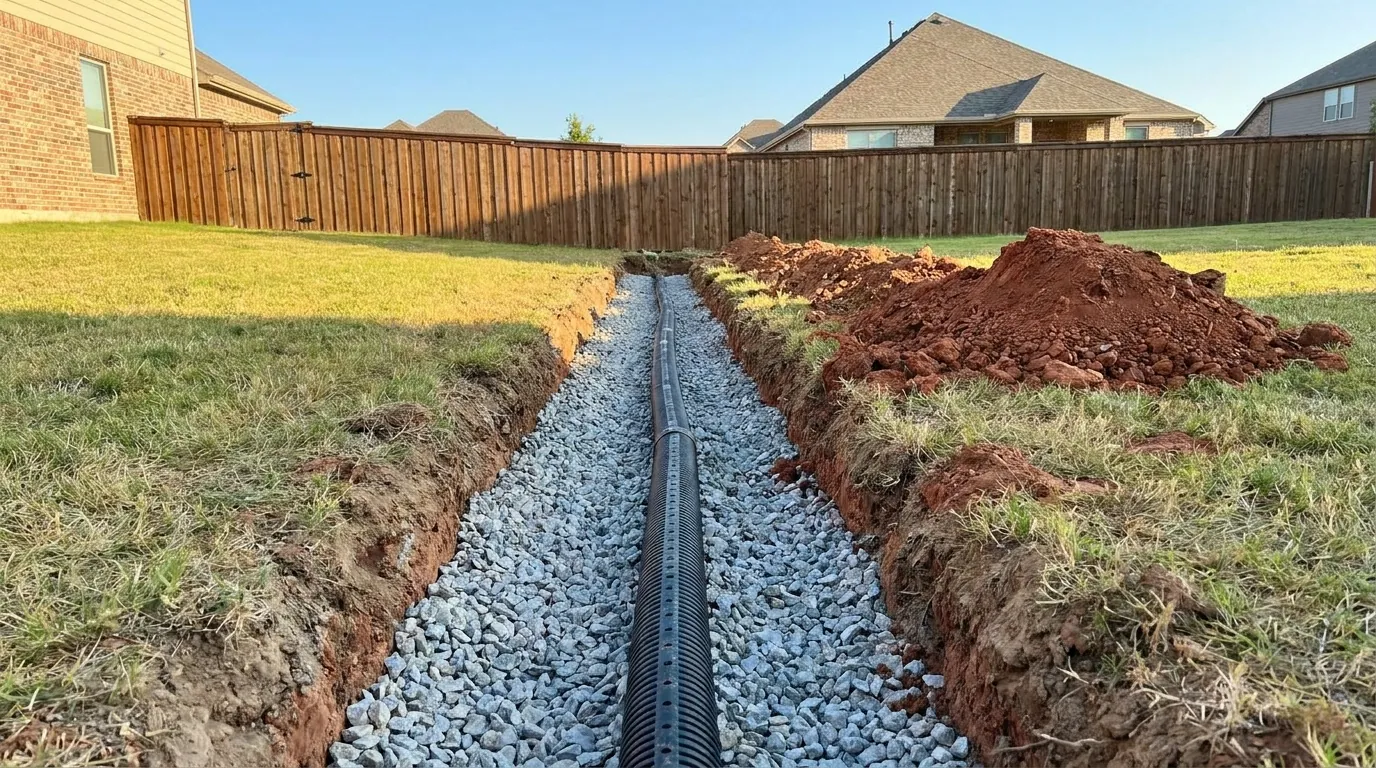
Drainage excavation is the work of building a system — swales, French drains, buried lines, and outfalls — that collects standing water and carries it off your property in a controlled way. In Frisco, where the clay soil holds water at the surface and won't let it soak away, it's one of the most common problems homeowners actually notice: a yard that stays soggy for days, a low corner that never dries, or water creeping toward the house after every storm.
The clay that causes the problem also shapes the solution. Because water won't drain down through it, we have to move water across and off the lot to a place it can legally go. Drainage excavation works hand in hand with site grading — grading sheds water to a path, and buried drains carry away what the surface can't. Where the water threatens a structure, it also ties into foundation excavation and the drainage built in around the slab.
Frisco's clay lots tend to show these symptoms clearly.
If puddles linger long after a storm has passed, the water has nowhere to go. On clay it can't soak in, so it has to be carried off.
A low area that never fully dries points to water collecting with no outlet — a prime candidate for a swale or buried drain.
Moisture pooling against the slab keeps the clay there swollen and stressed, which is the condition that leads to foundation movement.
Roof water discharged right at the foundation floods the soil where it does the most harm. Piping it away is a common part of a drainage plan.
A drainage system is designed around where the water is and where it can legally go.
We find where water collects, where it comes from, and where it can be released — a low corner, a street, or a storm connection.
Swales, French drains, and buried lines are laid out to collect the water and carry it to that outfall with continuous fall.
Trenches and channels are dug to a consistent grade so water always moves; on clay, that slope is what keeps the system working.
Perforated pipe, filter fabric, and gravel are set so water enters the line and soil stays out, then the system is tied to the outfall.
The work is backfilled and the surface is restored so it blends into the yard and any existing grading.
In sandy soil, water soaks straight down and drainage is half the problem it is here. Frisco's expansive clay does the opposite — it sheds water at the surface, especially after summer heat bakes it into a hard crust, so a sudden storm has water running and pooling within minutes. A drainage system on clay has to physically transport that water, because the ground won't take it.
Slope is everything in that transport. A buried line with even a slight belly becomes a spot where water and silt collect and the whole system backs up, so we cut every run to a consistent fall toward the outfall. We also plan for the volume North Texas storms actually deliver, not a gentle drizzle. Getting the water away from the house matters most of all: the same clay that floods your yard is the clay that moves under your foundation, which is why drainage and grading are usually planned together, and why trenching for those lines is done with trenching practices that hold slope and compact properly.
Show us where the water sits and we'll plan a drainage system that carries it off your lot and away from your foundation.
Drainage excavation for Frisco and nearby towns.
A swale is a shallow shaped channel that carries surface water along the ground, while a French drain is a buried gravel-and-pipe trench that collects water below the surface. Many clay-soil lots need both, working together toward the same outfall.
Because Frisco's clay doesn't let water soak down. Unlike sandy soil, clay sheds water at the surface, so if there's no path with fall to carry it away, it simply pools until it evaporates. Drainage excavation gives it that path.
To a legal outfall — a lower spot on the property, a street or curb, or a storm connection where allowed. Part of designing the system is confirming where the collected water can be released before we cut a single trench.
Yes, that's often the main reason for it. Keeping water from pooling against the slab keeps the clay there from swelling and shrinking against your foundation, which is a leading cause of movement on North Texas soil.