Water and sewer lines
Service and sewer runs need correct depth for cover and, for sewer, a consistent fall so waste flows. Getting that slope right the first time avoids costly rework.
Trenching in Frisco, TX for water, sewer, electrical, and drain lines. Safe, correctly sloped trenches dug and backfilled for North Texas clay soils.
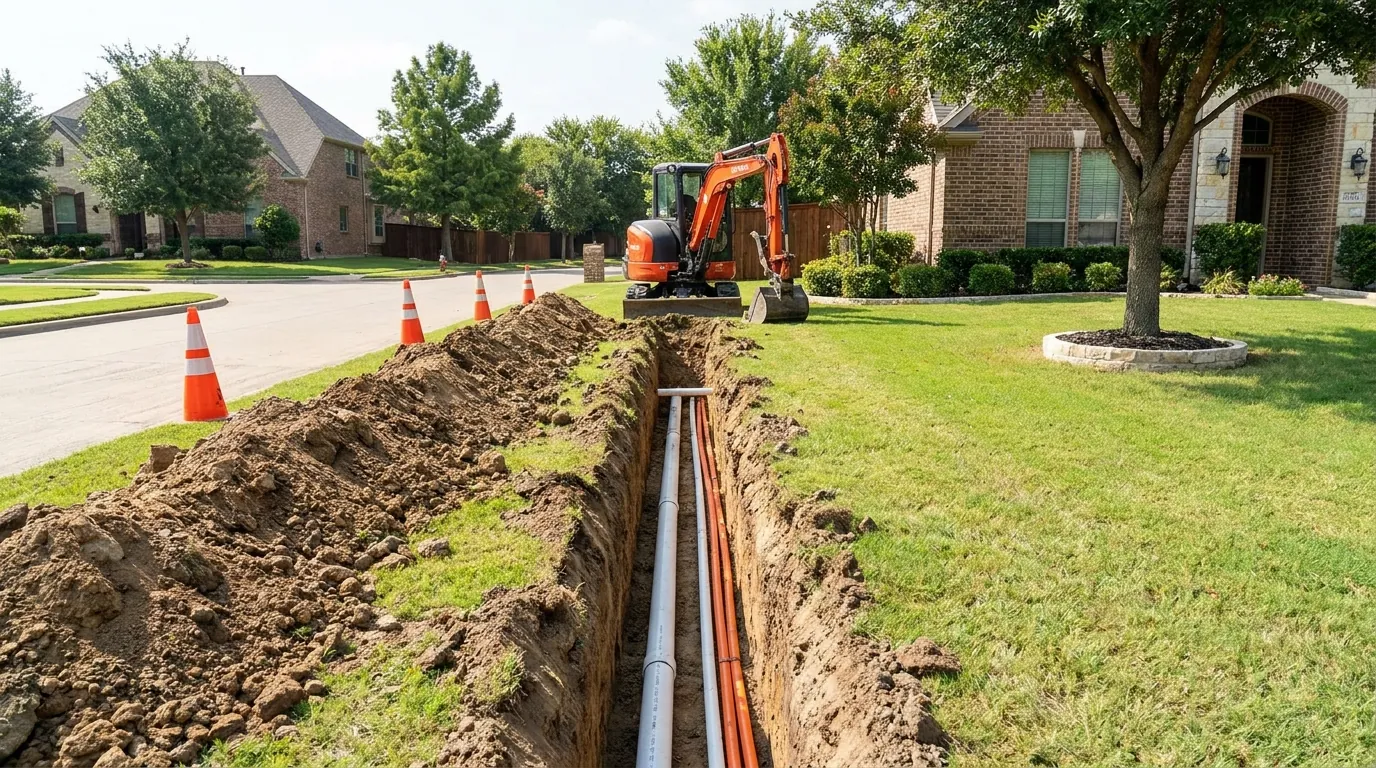
Trenching is the controlled digging of a channel to bury a pipe, conduit, or drain line. It sounds simple, but a trench that's dug at the wrong depth, on the wrong slope, or into an unmarked utility turns into a much bigger problem than the line you were trying to install. Around Frisco, we trench for water and sewer lines, electrical and low-voltage conduit, irrigation, gas services, and drain lines that need a precise fall to work.
The soil here makes trenching its own discipline. Frisco's clay is stiff and heavy, and the walls of a trench in that material behave differently than they would in sand or loam. We size the equipment and method to the run, keep the spoil staged, and backfill in a way that won't leave a sunken scar across your yard. When a trench is part of a bigger project, it ties into drainage excavation or the utilities feeding a new foundation excavation.
Different lines need different depths, slopes, and handling.
Service and sewer runs need correct depth for cover and, for sewer, a consistent fall so waste flows. Getting that slope right the first time avoids costly rework.
Power, low-voltage, and communication conduit are trenched to the required depth and bedded so they're protected once the ground is back over them.
Irrigation mains and gas services are trenched to spec with the routing planned around other buried lines and the yard's layout.
Buried drain lines depend entirely on slope. We cut the trench to a steady grade so water keeps moving toward the outfall instead of pooling in a low belly.
A safe, correct trench follows a clear sequence.
Before any digging, existing utilities are located and marked so the new trench avoids live lines. This step is not optional.
The route and the required depth are set based on what is being buried and the cover requirements, plus any slope the line needs to drain.
The channel is cut to width and depth with equipment sized to the job, keeping the spoil staged neatly beside the run.
The pipe or conduit is placed, bedded, and checked for correct slope and connections before anything is covered.
The trench is backfilled in lifts and compacted so it does not settle into a sunken line across the yard later.
Expansive clay is both a help and a hazard when trenching. It holds a wall better than loose soil, but it's heavy, slow to dig, and it moves with moisture — which means a trench left open through a rainy stretch can slump, and backfill that isn't compacted well settles as the clay shifts. That settlement is why you sometimes see a sunken line running across an older yard: the trench was never properly compacted.
We backfill in lifts and compact so the surface stays level over time, and we plan around Frisco's sudden storms so an open trench doesn't fill with water or collapse a wall. For drain and sewer lines, we hold a consistent slope the whole run, because in this flat-lying clay even a small dip becomes a spot where water and waste stop moving. If your project also needs the ground shaped first, that's site grading done before the trenching begins.
Tell us what line you're running and where it needs to go, and we'll plan a trench that's dug, sloped, and backfilled to last.
Trenching for Frisco and the surrounding area.
Always. Existing lines are located and marked before any trench is opened so the new run avoids live water, sewer, gas, and electrical. Skipping this step is dangerous and can be very expensive — it's not something we cut corners on.
It depends on the line. Water, sewer, electrical, and gas each have their own depth and cover requirements, and drain lines are set by the slope they need. We set depth to the type of line and the run's grade.
That's backfill that was never compacted. As clay soil shifts with moisture, loose backfill settles and the surface drops along the trench. Compacting in lifts as we backfill prevents that sunken scar.
Yes. Drain-line trenching is a big part of what we do, and it often ties directly into a drainage excavation plan. The key difference is slope — a drain has to be cut to a steady fall to keep water moving.