Slab and pad excavation
Stripping and cutting the building area to a working elevation, then preparing a firm, compacted base for a slab-on-grade foundation.
Foundation and basement excavation in Frisco, TX. An excavation contractor digging to stable bearing on North Texas clay for slabs and footings.
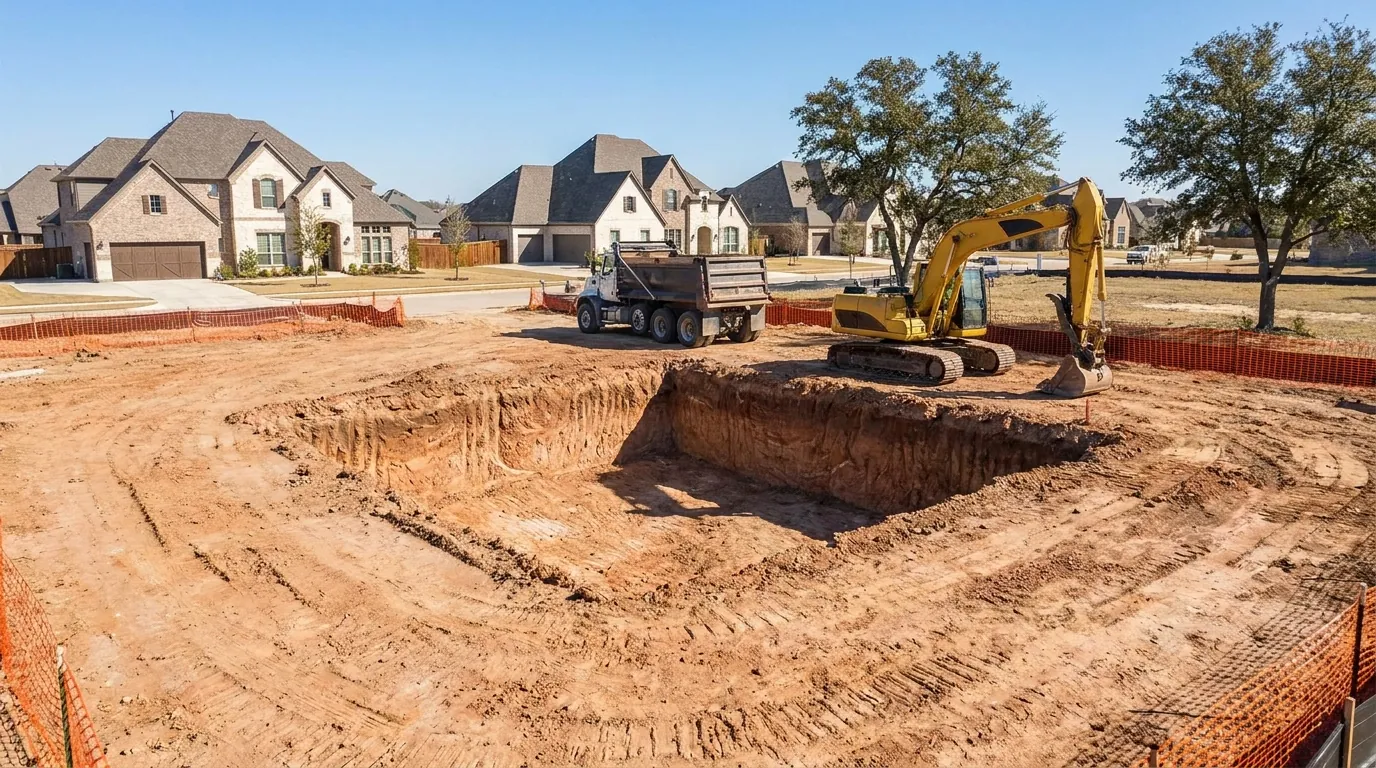
Foundation excavation is the work of removing soil to the depth and shape a structure's footing or slab requires, and preparing that base so the foundation has something solid to sit on. On North Texas clay, it's some of the most consequential work on the whole project — get the bearing, the fill, and the drainage right, and the foundation has a fighting chance against the soil movement this region is known for. Get it wrong and you're chasing cracks for years.
As an excavation contractor working in Frisco and towns like Allen, McKinney, and The Colony, we excavate for slab foundations, footings, and where a plan calls for it, deeper work like a basement. Every dig is matched to the plan and the actual soil we find in the hole. Foundation excavation ties tightly into site grading and drainage excavation, because a foundation is only as protected as the way water moves around it.
The scope depends on the structure and what the soil hands us.
Stripping and cutting the building area to a working elevation, then preparing a firm, compacted base for a slab-on-grade foundation.
Digging the trenches and pads for footings to the depth and dimensions the structural plan specifies, down to sound bearing soil.
Deeper excavation where a plan calls for below-grade space, with the walls and base worked to the design and drainage built in from the start.
Soft, wet, or organic soil that won't bear load is dug out and replaced with engineered fill compacted in lifts so the foundation sits on stable ground.
The dig follows the plan and the soil in this order.
The building footprint and elevations are staked from the plans so the excavation matches the design exactly, with room to work around the edges.
Topsoil and unsuitable material are stripped and the pad area is cut to the working elevation.
The excavation goes down to stable bearing soil or to the depth the plan requires for a basement or footings, removing soft or organic material along the way.
The base is shaped and compacted, and engineered fill is added and compacted in lifts where the plan calls for it.
Drainage provisions are built in before concrete goes down so water never sits against the foundation.
Expansive clay is the defining challenge for any foundation in this area. It swells when wet and shrinks when it dries out in the summer heat, and that movement is what cracks slabs and heaves footings. Foundation excavation is where you get ahead of it: digging out unsuitable material, reaching soil that actually bears the load, and building a base that won't move the way native surface clay does.
Moisture control is the other half of the story. Because Frisco sees hot dry stretches broken by sudden storms, keeping moisture stable under a foundation matters as much as the dig itself. That's why we build drainage into the excavation stage rather than treating it as an afterthought — provisions to keep water from ever ponding against the slab. On a wooded lot, the sequence starts even earlier, with land clearing before any excavation begins.
Share your plans and site, and we'll talk through the excavation your foundation needs on North Texas clay.
Foundation excavation across Frisco and the surrounding area.
It's set by the structural plan and the soil. The excavation continues until it reaches soil that can carry the load or hits the depth the design specifies for footings or a basement. On clay, soft or organic material near the surface usually has to be removed.
Native surface clay in this area moves too much with moisture to reliably support a foundation. Digging out unsuitable material and replacing it with properly compacted engineered fill gives the foundation a stable, predictable base.
They're far less common here than in other regions, largely because the clay soils and high water conditions make them more involved to build. Where a plan does call for a basement, the excavation and drainage have to be handled carefully — which is exactly what a basement excavation contractor plans for.
By reaching stable bearing, replacing bad soil with compacted fill, and building in drainage so moisture around the foundation stays even. Even movement, or no movement, is what keeps a slab from cracking.