Water stands after storms
Puddles that sit for a day or more after Frisco's sudden storms mean the ground has no fall to carry water off. On clay it can't soak away fast enough on its own.
Site grading and land grading in Frisco, TX. We shape lots to drain water away from foundations across the clay soils of Collin and Denton County.
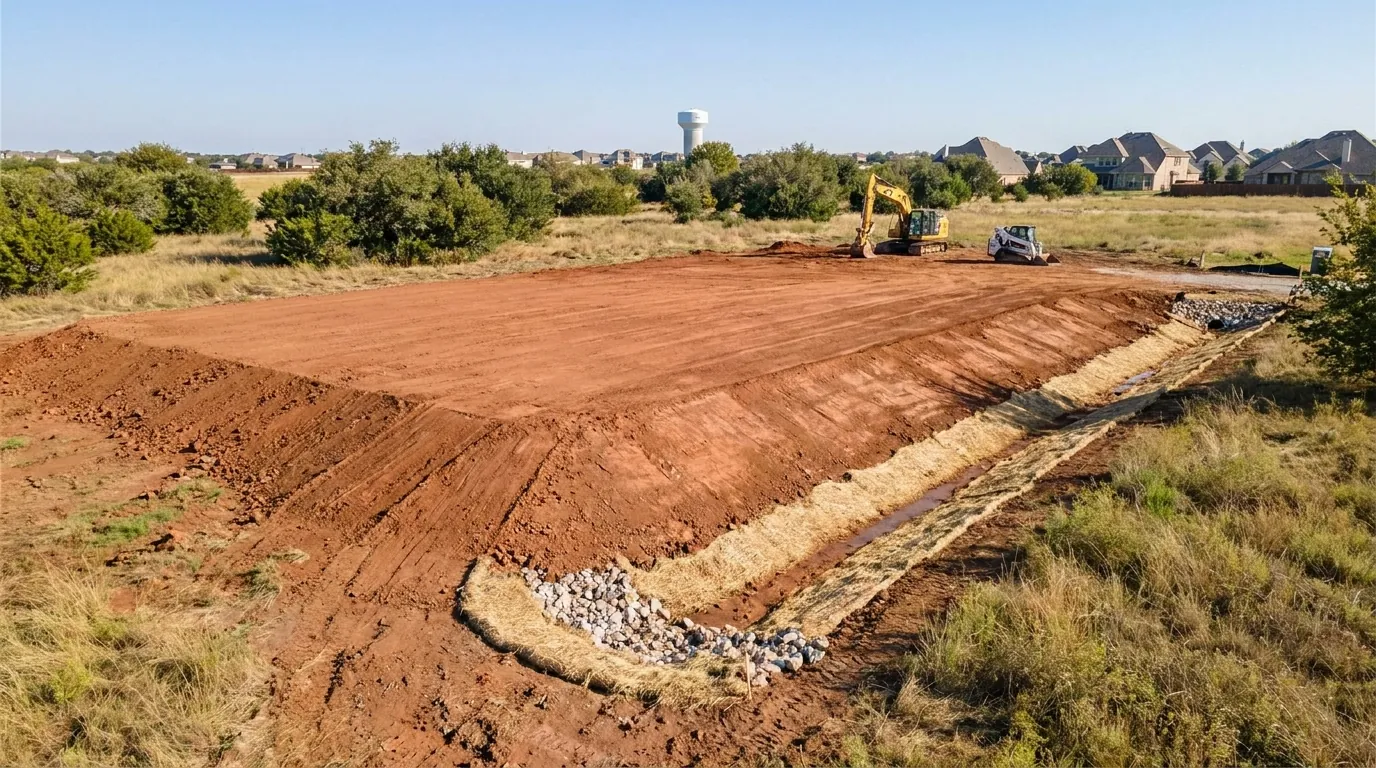
Site grading is the work of shaping the ground so water leaves your property in a controlled way instead of pooling where it can do damage. On the expansive clay soils around Frisco, that is not a cosmetic detail — it is the single biggest thing standing between a dry slab and a cracked one. Clay swells when it soaks up rain and shrinks hard in the summer heat, and if water is allowed to sit against a foundation, that swell-and-shrink cycle works right at the edge of your slab.
As a grading contractor working across Frisco and nearby towns like Prosper, Plano, and McKinney, we set finished grades that carry water away from the structure and out to a legal outfall. Whether you are prepping a new build, fixing a yard that floods, or getting a lot ready for a driveway or shop, good grading is where the site work starts. It ties directly into drainage excavation and, on a new build, into foundation excavation.
A lot with a grading problem usually tells you before the foundation does.
Puddles that sit for a day or more after Frisco's sudden storms mean the ground has no fall to carry water off. On clay it can't soak away fast enough on its own.
If the yard slopes back toward the slab, every rain drives moisture into the soil right where it does the most harm to the foundation.
Erosion channels and washed-out beds show water moving fast and uncontrolled across the surface instead of following a planned path.
A persistent damp corner against the foundation keeps that clay swollen year-round, which is exactly the condition that stresses a slab edge.
Every lot is different, but a typical grading job follows the same sequence.
We shoot elevations across the lot to find high spots, low spots, and where water currently collects. That data sets the finished grade and the fall we need away from the structure.
Usable topsoil is stripped and set aside so it can go back on top after the subgrade is shaped, rather than being buried or hauled off.
High areas are cut down and the material is moved to fill low areas. On clay, fill is placed and compacted in lifts so it does not settle unevenly later.
We build in swales and a continuous fall toward the outfall, tying into any drainage work or existing storm path.
Topsoil is spread back over the finished grade and the surface is smoothed so it is ready for sod, seed, or the next phase of construction.
The clay that dominates this part of North Texas holds water at the surface and moves as it wets and dries, so grading here is about more than getting a pleasant slope. Fill has to be compacted properly or it settles into the low spots you just filled, and the required fall away from a foundation — typically several inches over the first several feet — has to be built to survive years of that swell-and-shrink movement.
Frisco's hot summers bake the clay into a hard crust that sheds water almost like pavement, so when a sudden storm hits, a lot with no planned path floods fast. We grade for that reality: continuous fall, defined swales, and an outfall that actually carries the volume a heavy North Texas rain drops in an hour. If a lot needs trees and brush gone before we can shape it, that starts with land clearing.
If your yard floods, drains the wrong way, or you're prepping a lot for construction, reach out to talk through what grading your site needs.
Serving Frisco and surrounding Collin and Denton County towns.
A common target is a slope away from the foundation of roughly six inches over the first ten feet, though the exact figure depends on your lot and local requirements. The goal is continuous fall so water always moves away from the slab rather than pooling against it.
Frisco clay settles and shifts as it takes on and loses moisture. If fill is dumped without being compacted in lifts, it will settle unevenly and recreate the low spots you were trying to eliminate. Proper compaction is what makes a grade last.
Often yes. Regrading to build a defined path and fall, sometimes combined with drainage excavation, redirects standing water. We survey the lot first to see whether grading alone solves it or whether buried drains are also needed.
Yes. We handle site work from clearing and rough grading through finished pad grades, coordinating with foundation and drainage work so the whole site drains correctly before the build goes vertical.